The Perspective We Provide
A National Overview with a Focus on Jurisdiction and Local Needs
ECEC provision and services are generally delivered at a jurisdictional level, the NNN with its membership across the country is in a unique position to provide a National perspective which takes into account gaps and needs across jurisdictions.
A Multidisciplinary Approach with a Focus on ECEC Settings and Nutrition
The strength of the NNN’s approach is both in its breadth of expertise and its specific focus on ECEC settings and environments.
A Whole of Service and Setting Outlook with a Focus on the Diversity of Needs and Context
The expertise and knowledge within the NNN focuses on whole of service approach whilst also trying to understand the diversity of needs and contexts across services across the country and the staff, children and families within.
Our Policy Goals
ACECQA embedding national food provision expectations in National Quality Framework
All jurisdictions providing support to ECEC around food environment supported with an award scheme
Identification in nutritional policy communications as ECEC's as separate and distinct settings
Our Policy Briefs and Supporting Evidence Briefs
Click to download

POLICY BRIEF
Achieving Equality and Equity in the Provision of Food and Nutrition Support in Early Childhood Education and Care Settings: Opportunities and Actions for System Change in Australia
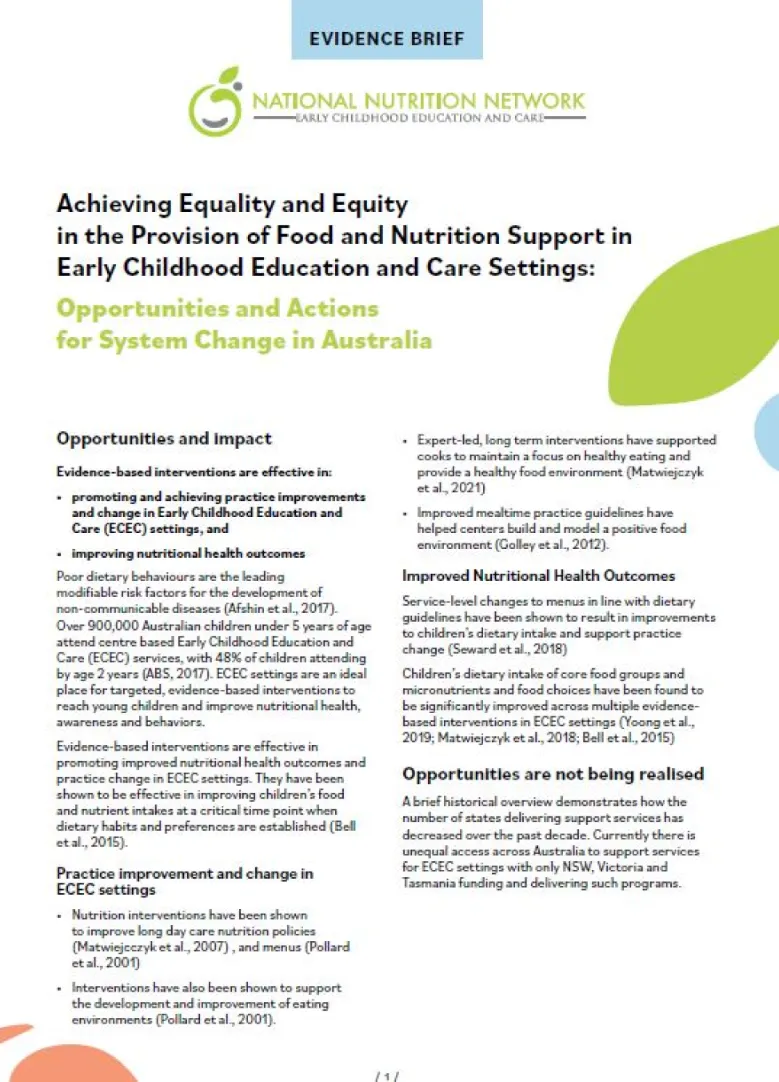
Whilst evidence-based interventions have been shown to be effective in promoting improved health outcomes and practice change in ECEC settings that consequently improve children’s food and nutrient intakes, there are currently only three jurisdictions within Australia that provide jurisdiction-wide free support services for ECEC settings in the areas of healthy eating.
Recommendations
- Ensure that government funded state-wide interventions are available in every jurisdiction across Australia and are reflective of the diversity of local needs across the whole jurisdiction.
- Ensure that newly developed support initiatives, programs, services and resources fill identified gaps.
- Ensure that funded interventions are based on principles of accessibility, greatest need and equitable access.
POLICY BRIEF
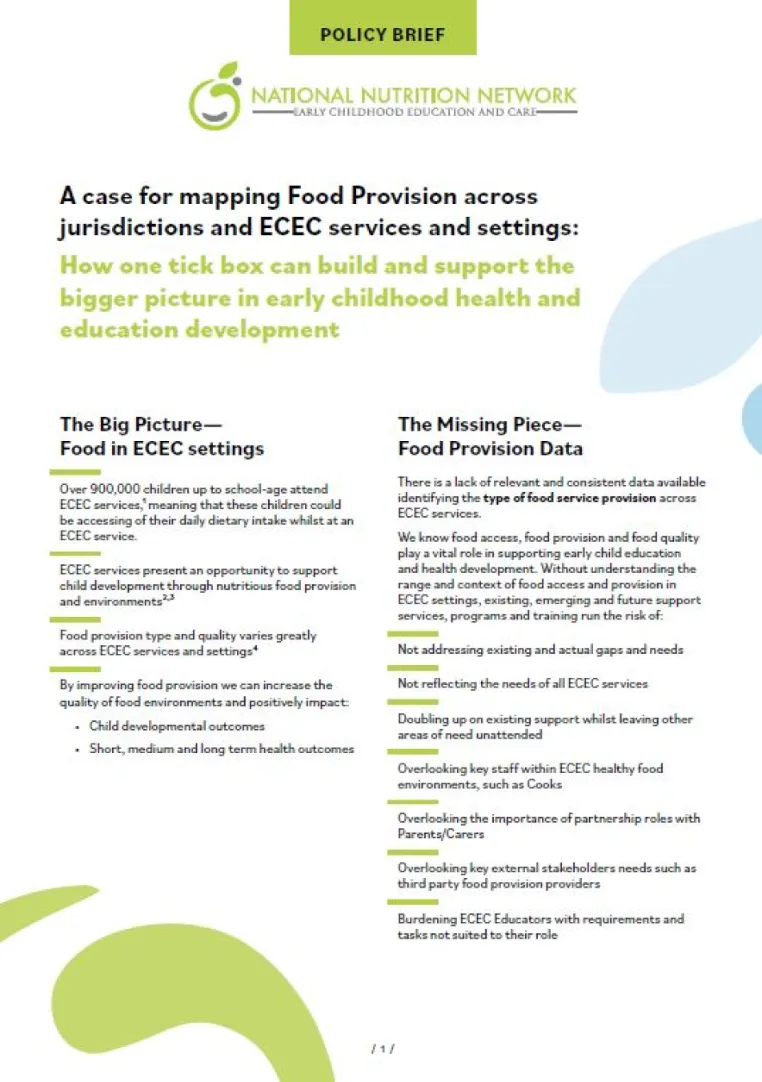
A Case for Mapping Food Provision Across Jurisdictions and ECEC Services and Settings: How One Tick Box Can Build and Support the Bigger Picture in Early Childhood Health and Education Development
There is a lack of relevant and consistent data available identifying the type of food service provision across ECEC services. We know food access, food provision and food quality play a vital role in supporting early child education and health development. However, without understanding the range and context of food access and provision in ECEC settings, existing, emerging and future support services, programs and training run a range of risks, and overlook potentials.
Recommendations
- To collect relevant and consistent data on Food Provision in ECEC Services.
POLICY BRIEF
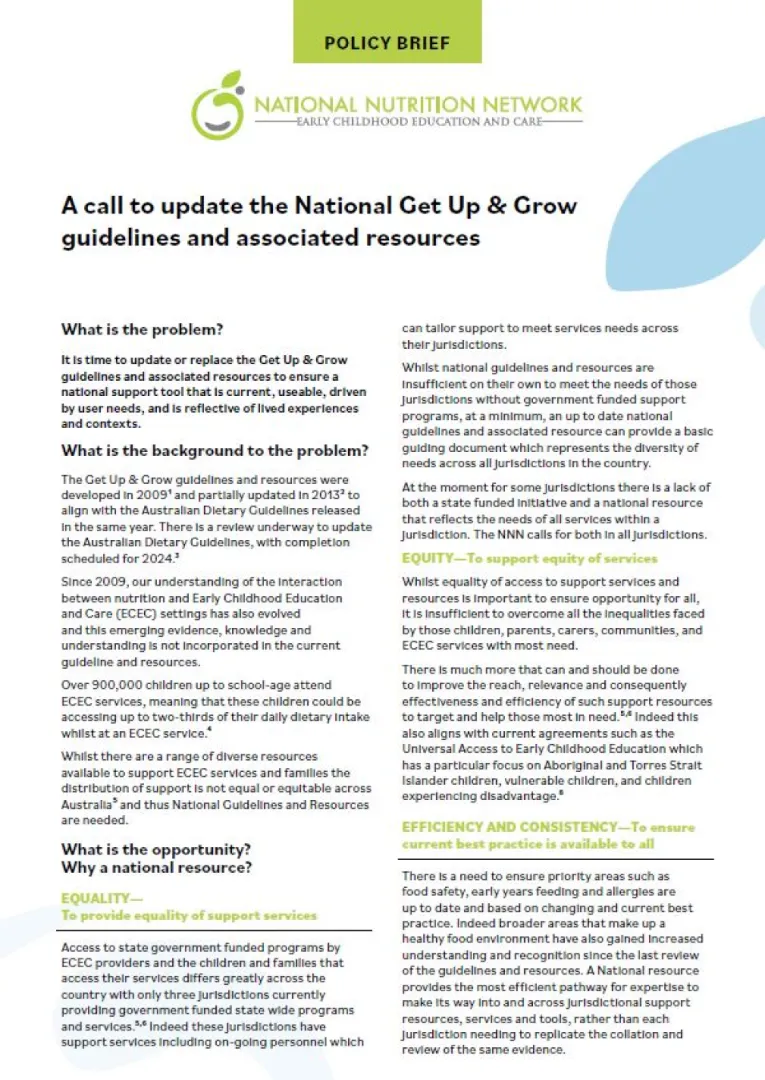
A call to update the National Get Up and Grow guidelines and associated resources
It is time to update or replace the Get Up & Grow guidelines and associated resources to ensure a national support tool that is current, useable, driven by user needs, and is reflective of lived experiences and contexts.
What a national resource should look like?
A national guide and resource should be jointly developed by ECEC and public health specialists. It should be designed based on the needs of all intended users and reflect the diversity of their contexts and lived experiences. This then leads to the opportunity to recognize and raise the importance of the role of ECEC in family food settings.
Select NNN policy briefs provide a starting point from which to begin to understand the diversity of ECEC service contexts as well as the contexts and lived experiences of the families and children who use ECEC services. A National guide or resource should be differentiated which ensures it reflects the diversity and variety of ECEC contexts and lived experiences. This will ensure that guides and resources developed have relevance to the whole system and therefore reach.
A national guide and resource should ensure all relevant topics and themes and associated questions relevant to ECEC services and the families they work with are included. This is to ensure all available evidence is identified, sourced and utilized. This process also highlights important gaps in understanding and ensures that any further or future research is driven directly by stakeholders and beneficiaries needs.
A national guide and resource should focus on how knowledge and information is utilised and implemented as well as ensure practice and place-based experiences are included to provide meaningful learning between ECEC services. In addition there is an opportunity to engage with the ECEC sector to develop innovative sharing tools, which ensures optimal engagement with the guidelines and resources that are developed.
EVIDENCE BRIEF
Achieving Equality and Equity in the Provision of Food and Nutrition Support in Early Childhood Education and Care Settings: Opportunities and Actions for System Change in Australia
What is the problem?
There is a lack of equality in the provision and accessibility of initiatives, programs, services, training and resources which support ECEC settings to provide safe and healthy food environments across Australia.
Support initiatives, programs, services and resources differ across jurisdictions and are either generic and free, customised and free or customised and at cost, resulting in unequal distribution and access to currently available support initiatives, programs, services and resources.
There is a lack of equity in the provision and accessibility of support initiatives, programs, services training and resources which support ECEC settings to provide safe and healthy food environments across Australia.
The ECEC settings, localities, children and families most in need of support services tend to have the least access to sustainable and long term support initiatives, programs, services and resources.
What is the opportunity?
ECEC services often provide up to two-thirds of children’s daily food intake and have an opportunity to create supportive environments for optimal nutrition and development.
Babies and young children have the highest rates of food allergy, providing education and training to ECEC services increases child safety and improve quality of life for both the child and their parents/guardians.
ECEC services are a pathway for engaging with families to optimize nutrition and food safety for children, particularly in jurisdictions that do not have strong and sustainable relevant public health networks.
Evidence and place based credible support initiatives, programs and resources have been shown to improve practice and change in ECEC food environments.
Knowledge and practice improvement in ECEC food environments have been shown to lead to improved nutritional health outcomes.
Increase nutritional and health outcomes support learning and development outcomes and help governments achieve health policy objectives.
Increased nutritional and health outcomes support learning and development outcomes and help governments achieve education policy objectives.
Request a Briefing
To request a briefing of any of the policy briefs please complete the following policy briefing form.
